GoHighLevel is a big American all-in-one platform, and for every Czech user it comes with one catch: it has no Czech interface. The menu on the left is in English, and so is every button and every item in the settings. You could live with that. The snag is that the English doesn’t stay inside. It seeps out to your customers: into the booking calendar, the email greeting, and the invoice.
For the first few days, it doesn’t matter. You click around, translate a few things in your head, and move on. It also helps your mood that one license replaces a whole shelf of tools. Problems start once that English interface speaks up in front of a customer.
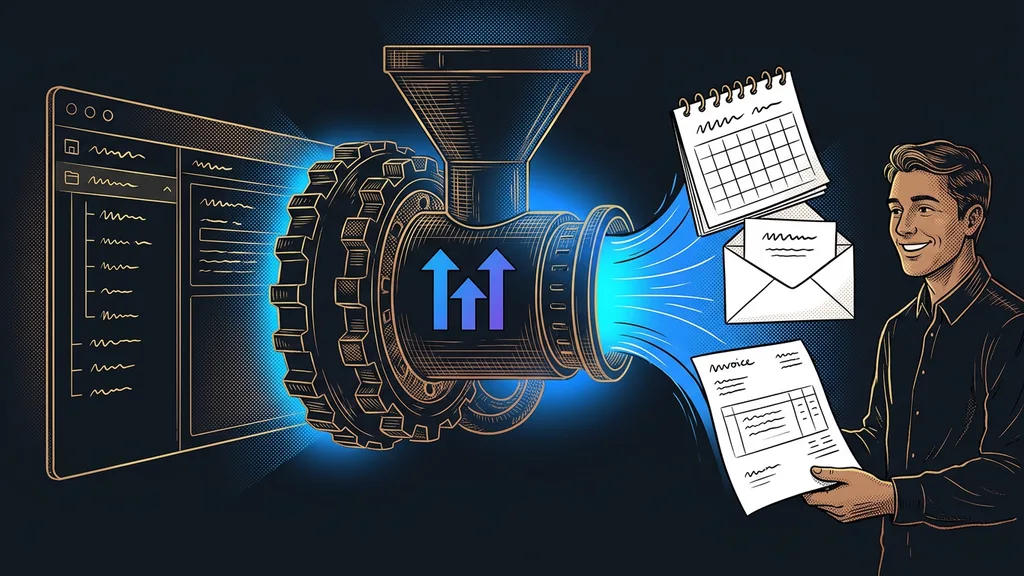
The booking calendar offers them a slot on “Fri, May 1” lasting “1 hr.” The confirmation email greets them with “Dobrý den, Jan” (hello, Jan), the name in the nominative, just as it came in from the form. Czech grammar wants “Jene” here. And the invoice for the order arrives in English, with no variable symbol (the payment reference Czech banks use) and no IČO (the Czech company ID number). At this point, it stops being your private struggle with a foreign language. Your customer is reading this.
You can put up with English in the admin. It’s worse when it reaches customers
Let’s separate the two right from the start. English inside the admin is just a one-time tax on a good tool. The real damage happens where it reaches the people you want to sell to.
GoHighLevel is American software through and through. Its default date format is MM/DD/YYYY, there’s no field where you can switch the currency (it follows the country in your business profile), and the interface stays hard-coded in English, so during your first week you spend more time figuring out what each button does than actually working. You can get past all of this.
“The platform works wonders. But the very first automated email it sent greeted my customers with ‘Dobrý den, Jan.’ It sounded like I’d sent them a machine-translated mass message.”
A business owner who had set up GoHighLevel on his own, following a tutorial from abroad, said that to me. And he hit the nail on the head.
Declension that ruins every other email
The most common leak is names. English doesn’t decline names, but Czech needs the vocative case when addressing someone and other cases in the middle of sentences. GoHighLevel, however, inserts the name through a merge field exactly as it’s stored, in the nominative. So “Dobrý den, Jene” (hello, Jan, in the correct vocative) suddenly turns into “Dobrý den, Jan,” and “připravil jsem pro Petru” (I’ve prepared this for Petra) comes out as “připravil jsem pro Petra,” with the name in the wrong form.
Every sentence like that quietly tells the customer a machine wrote to them, not a person. And nothing erodes trust faster. What’s more, cheap sending doesn’t mean the message even arrives. Without a properly set up sending domain, it lands straight in the bulk folder.
One-minute self-test
Find the last automated email or text message GoHighLevel sent to your customers. Does it address them in the vocative (“Jene,” “Petro”) or in the nominative (“Jan,” “Petra”)? If it’s the nominative, that’s exactly what every one of your customers is reading.
How I get GoHighLevel speaking Czech, through the customer’s eyes
Localizing GoHighLevel into Czech is work on three layers, and you can best judge it by what the customer sees afterward. And above all, by what they don’t.
The booking calendar. The customer opens the booking window and picks a slot on “Pátek 1. května” (Friday, May 1) lasting “1 hodina” (1 hour). Never “Fri, May 1” and “1 hr.” The widget’s labels are hard-coded in English and there’s no official translation, so I rewrite them on the fly, including the Czech declension of durations (“1 hodina,” “2 hodiny,” “5 hodin”) and our date formats. The client can’t tell there’s an English interface running under the hood.
The greeting in emails and text messages. The customer’s inbox then gets “Dobrý den, Jene,” not “Dobrý den, Jan.” For that, I create a separate field for the greeting and build the templates so the name always sits in the vocative. The message sounds like a person wrote it, not a merge field.
The invoice. And at the end, the customer gets an invoice with an IČO, a DIČ (the Czech VAT number), and a variable symbol that their accountant accepts without a word. An invoice straight from GoHighLevel can’t do that, so I send orders to Fakturoid (a Czech invoicing tool) or FAPI (a Czech invoicing and payments tool). I also watch the details an American wouldn’t think of: I store the IČO as text so it doesn’t lose its leading zero, and I keep prices including VAT.
What the customer sees
They pick a slot in Czech, the confirmation greets them in the vocative, and the invoice arrives with an IČO and a variable symbol. Along the whole way, they don’t run into a single English word and have no idea there’s an American platform under the hood.
The catch that costs the most: diacritics in text messages
One Czech habit costs real money. A text message with diacritics fits only 70 characters instead of 160.
SMS segment
A text message is sent in segments. Without diacritics, one segment holds 160 characters. As soon as a single “ě,” “č,” or “ř” appears in the text, the encoding switches and the segment shrinks to 70 characters. A longer message then splits into more segments, and you pay for each one separately. If you don’t know this, you’ll find out from the bill.
A message stretched over three segments costs you three times as much as a one-segment message, and with bigger sends, that difference in SMS costs adds up to an amount you don’t see coming.
Localize it yourself, or take a ready-made Czech version
That leaves the question you should ask yourself before anything else: localize GoHighLevel yourself, or take a version where it’s already done? The honest answer: it depends on who you’re building it for.
White-label version
White-label means the same tool runs under another company’s brand, with that company’s own support. A company “wraps” GoHighLevel, gives it a Czech interface, Czech invoicing, and Czech pricing plans, and sells it as its own product. You work in Czech and don’t have to think about the platform’s American origins.
The first route is to buy a license directly from HighLevel and handle the localization yourself or with an implementation partner at hand. It pays off if you want to resell the platform to clients and need the agency level for that. The second is to take a ready-made Czech white-label version, where you don’t have to deal with the localization at all: not the widget, not the invoices, not the sending domains. For solo business owners and small businesses running only their own business, it’s usually faster and cheaper.
In the Czech Republic, I know of two such versions, and I used to work for one of them. Both localize GoHighLevel into Czech and add Czech support. Whether your own license or the ready-made Czech route pays off better for you, I break down in a separate comparison, where I also mention other GoHighLevel alternatives.
Localizing GoHighLevel into Czech, in a nutshell
- Switch your business country to Czech Republic, or the system will stubbornly keep calculating in dollars.
- Give the booking widget a translation so it speaks Czech, declined durations included.
- Build email and text message templates around the vocative, not around a bare merge field.
- Move invoicing out to Fakturoid or FAPI, because the platform’s invoice isn’t good enough for Czech accounting.
- Watch the diacritics in text messages so a short message doesn’t split into expensive segments.
GoHighLevel is a global platform, and it stays one even if you have to talk to it in English in the admin. In the end, a Czech implementer has just one job: make sure the English stays in the engine room and only Czech reaches the customer. Leaving the localization to the default settings is the one option where the customer can tell something’s off.