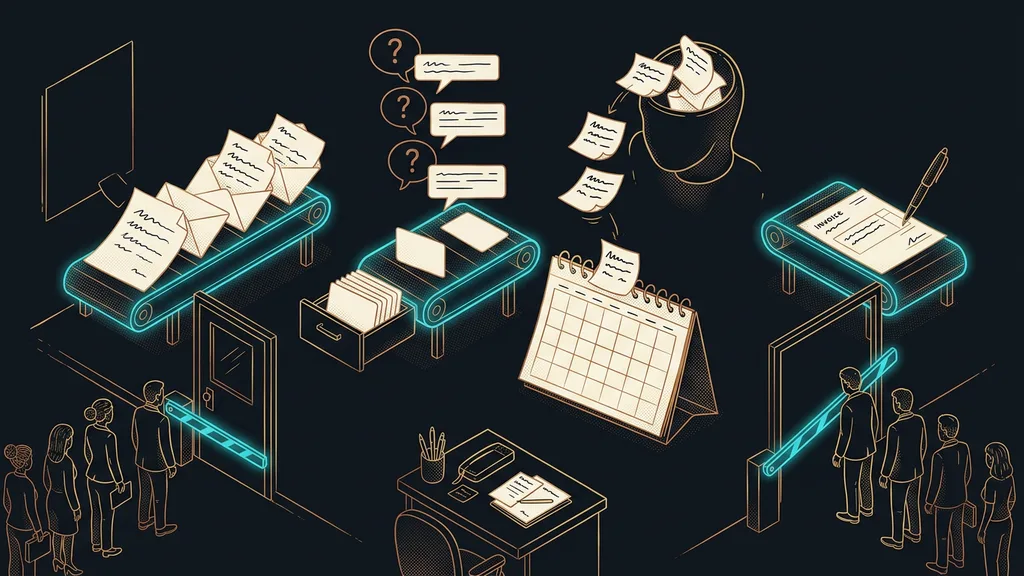
Trying AI in your business is cheap. Evaluating it is hard. The subscription takes five minutes to turn on, the team plays around with it for a week, generating texts, and then the month flies by and nobody can say whether anything changed. Just one thing is missing: a date and a number.
According to this year’s Deloitte survey of Czech companies, 85% of them feel AI brings benefits. Seven percent have measured it. That gap matches what I see in consultations. There’s almost always a feeling and almost never a number.
Plan the month backward, starting from the decision
First, decide what you’ll compare on day thirty. Only then get started. If you flip the order, after a month you’ll end up debating whether it was worthwhile, and that kind of debate has no winner.
Baseline number
A figure describing where things stand today, written down before anything changes. How many hours a week the routine eats up, how often it repeats, how many errors it produces. You can’t reconstruct it after the fact, because a month later nobody remembers how things were before.
I covered the order of steps, meaning pilot, then process, and only then the team, in my article on how to roll out AI in your business so it doesn’t fizzle out. This piece goes one level deeper and looks at what happens in that first step, day by day.
After a month, I don’t want to hear that it was interesting. I want to know whether the work took less time than last month.
Week one: measure, don’t change
For the whole first week, everything runs the old way. All you do is write down three numbers about the one routine you’ve picked. It sounds like a wasted week, and it’s the most important part of the month.
The routine you pick has to be narrow and repetitive. Month-end paperwork for invoices works well, because invoicing can be boiled down to a single sentence and the result shows up in money. If you pick something you do twice a year, you’ll have nothing to compare after a month.
Three numbers really means three, not a spreadsheet with twelve columns. Time, frequency, and error rate. As soon as someone adds a fourth and a fifth, nobody keeps filling them in after two weeks, and the measuring falls apart before the month is over.
One-minute self-test
Right now, try saying out loud three numbers about the routine you want to change: how many hours a week it takes, how often it repeats, and how many errors it produced last year. If you hesitate on any of them, you have your first task for this week. Don’t start the month without those three numbers.
Weeks two and three: go live, but keep it narrow
From week two, the system does the routine and a person checks it. Not the other way around. At this stage, the check is complete: every output gets looked at, even when most of them are fine.
Week two mostly goes into fine-tuning and training one person. It shouldn’t be a lecture on artificial intelligence. The training that helps most is built around the person’s own work, so they walk away with something finished, not notes.
In week three, the checks gradually loosen. This is where quality shows, because a well-built AI can check its own work and, above all, speak up when it isn’t sure. A system that knows how to stop and ask needs less watching than one that never hesitates.
Safeguard
While the first month is running, nothing goes to a client without human approval. The system prepares, a person sends. It’s a way to keep the risk inside one routine and out of your customer relationships, rather than a lack of trust in the technology.
The way back
A way of returning to the original process, agreed in advance, in case the new routine doesn’t work. If you have one, you’re risking one month of one routine. If you don’t, you’re risking your operations, and out of caution you end up trying nothing.
Day thirty is a decision, not a debate
On the last day, you pull out the three numbers from week one and put the same three numbers for the past month next to them. Either the difference is visible or it isn’t. Nothing in between.
The decision has three possible outcomes, and all three are fine. You continue and add a second routine. Or you continue with adjustments, because the numbers barely moved. Or you go back, because they didn’t move at all. Nobody likes the third outcome, and yet it’s the most valuable, because it cost a single month and left the rest of the company untouched. Plus, you know exactly why, so in six months you can come back with a better brief.
When the first month doesn’t pay off
This won’t suit anyone who doesn’t have a single routine they can put a number on. Without repetition and without a number, there’s nothing to compare, and the month ends with an impression. It also doesn’t pay off if you want to throw AI at five areas at once, because after a month you can’t tell which one worked. Five experiments running at once look bold, and not one of them can be evaluated.
One honest limitation, too. This plan is built for small businesses and one routine. If you have departments, approval loops, and three systems that don’t trust each other, a month only covers the preparation. So start with the same cheap first steps, just in one department, and plan for two months instead.
The whole month in a nutshell
- Pick one narrow routine that repeats at least weekly.
- In week one, change nothing and write down three baseline numbers.
- Agree on the way back before you launch anything.
- In week two, take the routine live with full checks and train one person.
- In week three, loosen the checks and watch whether the system knows how to stop and ask.
- On day thirty, compare the three numbers and decide: continue, adjust, or go back.
A month after which nobody can say whether anything changed is wasted for one reason: nobody asked at the start what would be compared at the end. The AI isn’t to blame. Thirty days is a short time for a revolution. For one honest number, it’s plenty.