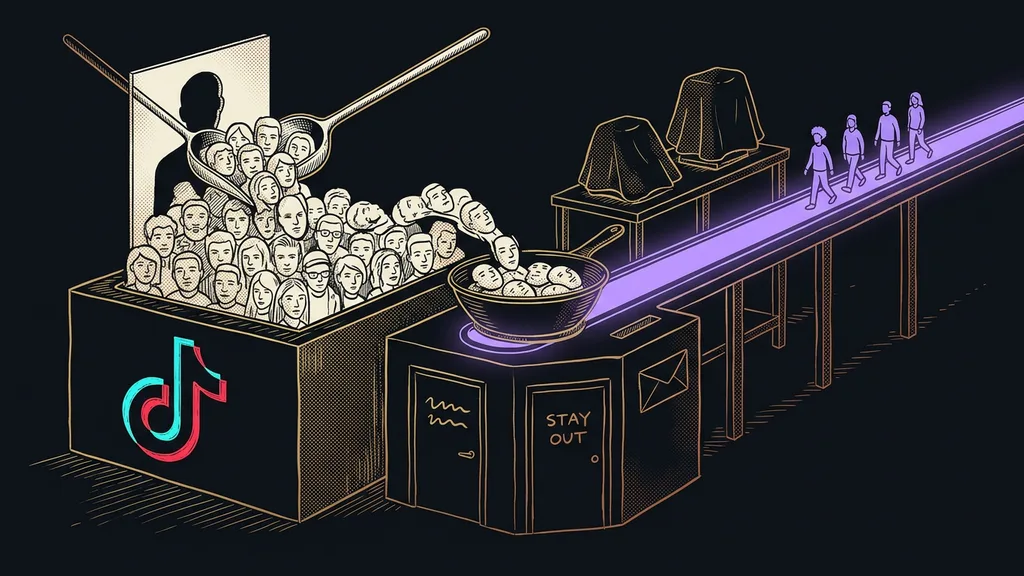
The question of whether to go on TikTok comes up in every other consultation. The answer is usually based on a feeling. Either it’s a network for kids, or everyone’s there and we have to be too. Both are just impressions. But you can’t pick a channel based on an impression, because it costs you time every week.
I’ve asked myself this question twice, for two different brands, and answered differently each time. Yes for my breathwork brand, no for AI and business systems. The difference came down to who’s on that network, not to what I can film.
Audience first, content second
You choose a channel based on who’s waiting for you there, not on what happens to be popular right now. For TikTok in the Czech Republic, that can be calculated fairly well.
Here are the numbers as of summer 2026: roughly 2.1 to 2.2 million adult users, or just under 23% of the population. That’s the second-lowest figure in the entire European Union. On top of that, growth has slowed from 19% a year to 4%, and one independent Czech survey from spring 2026 even measured a drop in regular users from 20% to 18%.
Six out of ten users are women. And one figure is missing entirely: how many people aged 30 to 50 are on Czech TikTok can’t be read from public data. Globally, people under 24 make up more than 60% of users, so caution is in order.
Completion rate
The share of viewers who watch a video all the way through. On TikTok, it’s the only signal the platform itself has publicly called strong. TikTok never published the well-known ranking of shares, saves, comments, and likes. That ranking is marketers’ interpretation, and repetition turned it into a supposed rule.
You don’t choose a channel based on what’s popular right now. You choose it based on who’s there and what it will cost you every week.
The one number that really decides things there
On TikTok, what decides things is whether people watch the video to the end. Everything else is derivative or guesswork. That’s why everything hinges on the first few seconds. The vast majority of viewers decide right at the start whether to stay with a video. So a slow start costs you most of your viewers, not just a few. That’s unpleasant for anyone used to a calm introduction. Your first sentence has to be the main one. Introductions, context, and greetings either fit in at the end or don’t make it in at all.
Video length: two truths that only seem to contradict each other
Short videos have a higher completion rate; longer ones bring more watch time. Both are true, and each drives something different.
In analyses of large samples, videos under half a minute get the most people watching to the end, around 62%. For videos over a minute, it’s 48%. Yet those same longer videos get more than 40% more reach than the shorter ones, and almost two-thirds more watch time.
The explanation is simple. Distribution is driven by total watch time, while audience engagement is driven by how many people watch to the end. They’re two different currencies, and you can’t add them up. In practice, that gives you a main range of 20 to 60 seconds, with longer pieces saved for tutorials and stories. One more thing: photo carousels look tempting because they’re quick to make, but they get only about a fifth of the views a video gets.
One-minute self-test
Answer three questions. Is my customer among those two million people? Can I show my topic in half a minute in a way that makes sense even without sound? And do I have four hours a week for three months? A single no is enough reason not to go for it.
A decision you can evaluate
You enter a channel for a fixed period, not for good. For myself, I set it up as a 12-week trial with a cap of four to six hours a week and three to four videos.
You have to write the threshold down in advance, or after 12 weeks you’ll be deciding by feel again. Mine goes like this: a median of at least 800 views, at least one video over 5,000, and at least 30 clicks from the profile. If it doesn’t work out, the channel gets shut down with no regrets.
Two rules go with it. You count the median, not the average, because one hit lifts the average and hides the fact that the rest isn’t working. And you don’t draw conclusions from five videos. You can start to read something at around eight, and you can trust the numbers at around 15 to 20.
Hybrid video production
A way of filming where the picture and voice stay yours, but AI takes over everything around them: editing, captions, audio leveling, and versions for other networks. One video then takes tens of minutes instead of hours, so three a week can fit alongside your regular work.
So AI takes over the editing and picture correction, for acted pieces a spot gets made straight from the brief, and the finished video goes out to every network from one place. The same work also covers Reels and Shorts, so even a trial you shut down isn’t wasted. The numbers then flow into one dashboard where you can compare TikTok with your other channels, not just with itself.
Who TikTok isn’t worth it for
So who isn’t TikTok worth it for? Anyone selling to businesses. There was no sign of the Czech professional community there, and decisions about a bigger contract don’t get made over a 30-second video.
It also doesn’t pay off if you have no one to put in front of the camera. You can’t make up for that by buying templates: what TikTok punishes is unoriginality, not AI, meaning the same tool and the same template as everyone else. And then there’s the last group: people still figuring out where to start with AI and content. TikTok usually comes far down the list, and the first steps look quite different. For my AI business, I said no, even though I can make videos. The audience I’m looking for just isn’t there.
The whole decision in a nutshell
- First, estimate whether your audience is among those two million Czech users.
- Set a cap on weekly hours and a length for the trial, say 12 weeks.
- Build your videos for completion: main sentence first, captions always, 20 to 60 seconds long.
- Write down in advance the numbers at which you’ll continue and the numbers at which you’ll stop.
- Count the median, not the average, and don’t draw conclusions from fewer than eight videos.
- Post the same videos to Reels and Shorts too, so the work isn’t wasted.
Two brands, two different answers, and neither was about what I can film. The question from those consultations can’t be whether TikTok works, because there’s no honest answer to that. The real question is whether your people are there and whether you have four hours a week for them. You can tell a good channel decision by the fact that you’re also able to reverse it.