Will it pay off? Most businesses answer that question by gut feeling. That’s not carelessness; there’s simply nothing to lean on. What gets written in Czech about automation ROI deals almost exclusively with production lines, warehouses, and robots. For office work, where nothing spins and nothing lights up, nobody has written a calculator.
For a long time, I eyeballed it myself. It seemed obvious that it would pay off, so I set it up and moved on. Then a client asked me how much it had actually paid back, and I couldn’t prove it. Since then, I calculate it in advance even for the smallest things, and it takes a few minutes.
Why ROI is so hard to calculate for office work
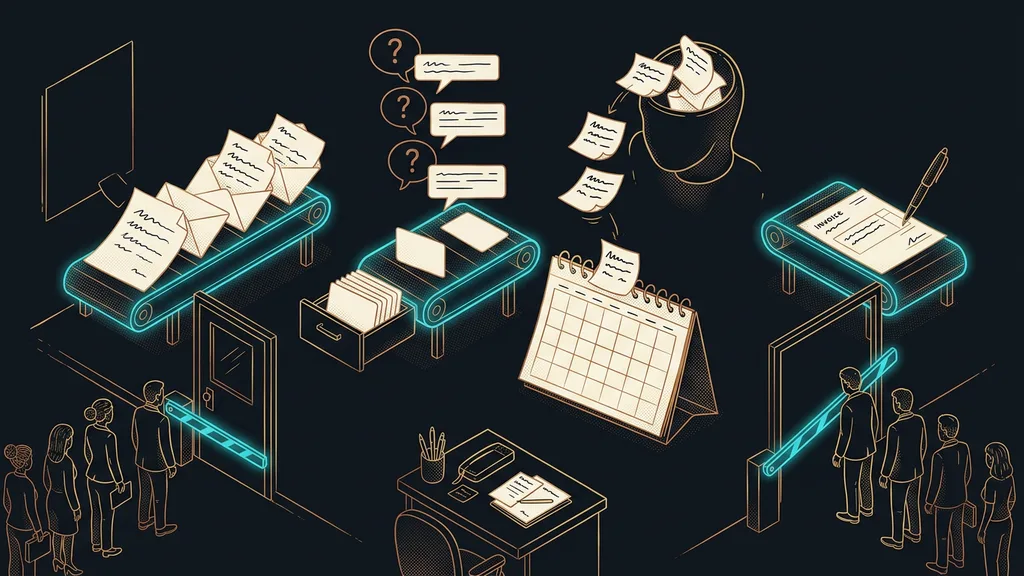
Because the baseline number is missing. With a production line, you know how many units it makes per hour. Nobody measures manual office work, so after the change, there’s nothing to compare against.
You can see it in how whole companies are doing, too. According to Deloitte’s spring survey of Czech companies, 85% of them feel the benefit of AI, but only 7% can measure it. That gap comes down to one note nobody made in time, not to technology or money.
Baseline measurement
A record of where things stand before you touch them: how many hours the work takes, how often it repeats, and what it costs when it’s done badly. It takes ten minutes, and without it, ROI can later only be estimated, not calculated.
ROI gets calculated in the ten minutes you set aside before you start, not after a year of running.
The five-line formula
It fits on the back of an envelope and needs no spreadsheet. Five lines, three of your numbers, and one division at the end. It always calculates one step, not the whole business, because AI gets rolled out one measurable step at a time.
1. Hours. How many hours a week that one specific task eats up. One thing, not a whole area of work and not “admin”: say, copying details from inquiries into quotes, a job where the finished document can generate itself.
2. Cost per hour. The full cost of an hour for the person doing the work, including payroll taxes and overhead. If you’re self-employed, it’s your own rate. This is the number people underestimate most often.
3. How much of it the system takes off your plate. Never all of it. Checking and exceptions stay with a person, so lowball the estimate. If the ROI works out even with a lowball estimate, the decision is easy.
4. What it costs. Two amounts: the one-time setup and the monthly running cost. Count the time you put in yourself as part of the setup.
5. The division. Hours saved times cost per hour times four, minus the monthly running cost. Divide the setup cost by that. The result is the number of months until it’s paid off.
Where do you get these numbers? The most honest way to find the hours is to actually write them down for one single week instead of estimating them from memory. Your accountant can work out the full cost of an hour in a few minutes. And the setup cost and the monthly running cost are in the quote you’re holding.
Try it now
Pick the one task whose time drain bothers you most today. Write down three figures for it: hours per week, the full cost of an hour, and a lowball estimate of how many of those hours the system would take over. Without those three numbers, there’s no point discussing automation, not even with me.
Three places where people get it wrong
The formula is easy. The mistakes happen when plugging in the numbers, and they’re the same three every time. All three pull the result in the same direction: toward a number that looks better than reality.
First, people use net pay instead of the full cost of an hour, a big difference that shifts the result by months. Second, they eyeball the savings, usually too optimistically. Third, they forget the running costs: the monthly fee also comes with time for checks and the occasional fix.
Invoicing shows this best. Half an evening of pulling documents together by hand shrinks to one sentence and a check, but the check doesn’t disappear, and it belongs in the calculation.
Payback period
The number of months it takes a solution to pay for itself out of its own savings. It’s a more honest figure than percentages, because it can’t be inflated: either it fits into a reasonable time frame or it doesn’t. My limit is six months for an operational task and a year for a bigger overhaul.
What to do when it’s a close call
Instead of a bigger solution, take a smaller task. At that point, the formula is saying “differently,” not “no.” A close result almost always means you went for too small a saving with too big an overhaul. For a small business, it’s often a sign that one of the cheap first steps will do.
The other option is to measure again after a month of live operation. That’s why it pays to have a report that builds itself: you don’t have to hunt for the number, because it’s waiting for you. And with a real number instead of an estimate, the calculation comes out either a clear yes or a clear no.
When it isn’t worth it
It won’t do anything for someone who wants to automate work that can’t be measured. Without hours or counts, there’s nothing to plug in, and the formula returns nonsense. Likewise, there’s no point calculating ROI for a task that comes up once a year. There, something else entirely decides it, such as how many mistakes creep into it each time and what those mistakes cost.
The whole calculation in a nutshell
- Pick one task, not a whole area of work.
- Before you touch it, take a baseline measurement. It takes ten minutes.
- Add the full cost of an hour for the person doing it today.
- Lowball your estimate of how many hours the system will really take off.
- Divide the setup cost by the monthly savings after subtracting the running cost.
- After a month of live operation, measure again and correct the calculation.
Will it pay off? That question has a boring answer: nobody knows for sure in advance, and nobody needs to. You just need to know where to look, and you already have all three numbers in-house. A business that has them written down decides in five minutes. A business that doesn’t have them spends six months talking about it and ends up going with whoever sounded more convincing.