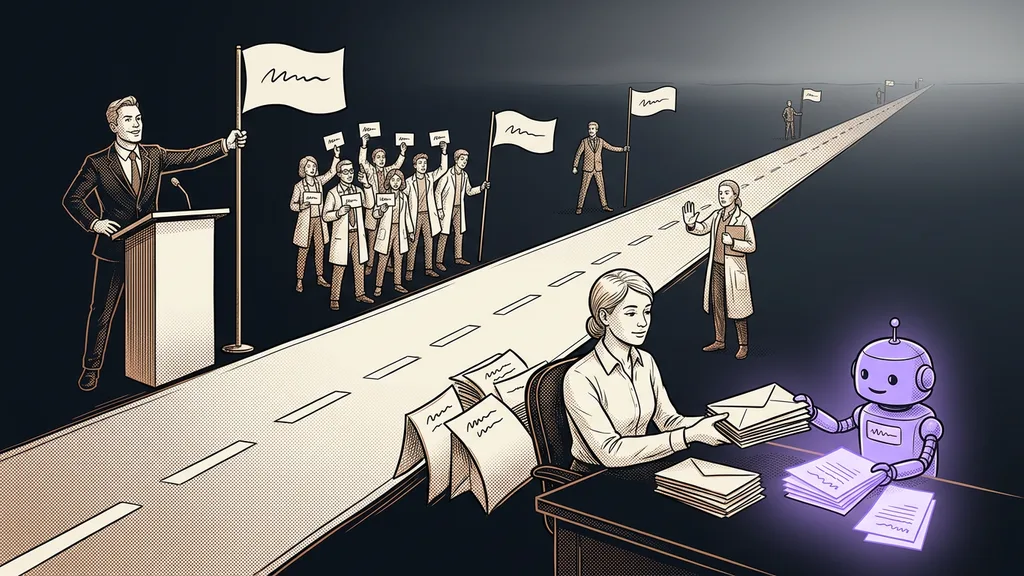
When superintelligence arrives depends mostly on who you ask. AI company CEOs talk about years, researchers in surveys about decades. And since September 2026, US government documents have used the word for ordinary AI. The short answer: nobody knows the exact date, and estimates differ by decades. For business decisions, though, that means surprisingly little.
Since the end of September, I keep hearing the same question in consultations: “Shouldn’t I hold off on AI until the real thing arrives?” I get it. When the news tells you a machine smarter than humans is coming in a few years, you don’t want to pay today for something that’ll be obsolete tomorrow. But the answer to that question doesn’t lie in any date.
Who’s promising superintelligence within a few years
The nearest dates come from people who are building superintelligence, or something like it, themselves. And they’re not all talking about the same thing.
Every date has a sender and a question it answers. Without them, it’s just a number that sounds precise.
- Sam Altman of OpenAI wrote in his essay The Intelligence Age on September 23, 2024, that we may have superintelligence “in a few thousand days,” though it may take longer. Fortune calculated that two thousand days is five and a half years and five thousand is just under fourteen.
- Dario Amodei of Anthropic writes about “powerful AI” rather than superintelligence. He compares it to “a country of geniuses in a datacenter,” and in his view it could be a year or two away, though it may take considerably longer.
- Meta merged its AI teams into Meta Superintelligence Labs in June 2025, and Mark Zuckerberg talks about “personal superintelligence for everyone.”
- Ilya Sutskever co-founded the company Safe Superintelligence in 2024. Microsoft built a team under Mustafa Suleyman with a goal it calls “humanist superintelligence.”
None of them has named a specific year. Altman’s “few thousand days” spans more than eight years, and Amodei himself adds to his “year or two” that it may take considerably longer.
A date with a return address
An estimate where who says it matters as much as what they say. An AI company CEO needs investors, talent, and customers, and a near-term goal helps with all three. That doesn’t make the estimate untrue. You just read it differently from a summary of thousands of researchers’ answers.
What researchers say: a 50% chance around 2047
The best-documented estimate comes from the AI Impacts survey of 2,778 researchers who had published at top AI conferences. It came out in 2024, and in the peer-reviewed journal JAIR a year later. It doesn’t ask about superintelligence directly. The closest question is when unaided machines will outperform humans at every task.
Taken together, the answers give a 10% chance by 2027 and a 50% chance by 2047. A similar survey a year earlier put the same point 13 years later. So the estimates are moving, and fast.
The 50% estimate
The year by which researchers, taken together, think something is as likely to happen as not. It marks the midpoint of a wide range of answers rather than a calendar date or a promise, and researchers already give a 10% chance by 2027.
Why the estimates differ by decades
Because each one measures something different. The AI Impacts survey shows this best. When it asked researchers about machines handling every task, the midpoint came out around 2047. When it asked about the full automation of all human occupations, the 10% chance fell on 2037 and the 50% chance not until 2116. Between machines handling all tasks and all occupations being automated, the answers put almost seventy years.
The second reason is vocabulary. AGI has no single definition, and since September 2026, superintelligence has had two meanings. Under an order the White House published on September 29, US federal agencies are to write “Super Intelligence” instead of “Artificial Intelligence.” So in their documents, superintelligence already exists today, just as a new name for an old thing. I break down both meanings in my article on what superintelligence is, and the difference between narrow AI, AGI, and superintelligence in an overview of three terms that people mix up.
Dates also come from those who warn against superintelligence. On October 22, 2025, the Future of Life Institute called for a ban on developing it until there’s broad scientific consensus on its safety and strong public support. According to its poll, 64% of American adults think superhuman AI shouldn’t be developed until it’s proven safe. There’s a serious debate about the risks. In the AI Impacts survey, 68.3% of researchers think good outcomes from superhuman AI are more likely than bad ones. At the same time, a large share of respondents allow for a small chance of a very bad outcome.
Why the date matters less for your business than it seems
The decisions a business makes this month rest on what tools can do today. The year 2047 doesn’t come into it. An assistant that sorts your email in the morning or transcribes a meeting is narrow AI, and it isn’t waiting for superintelligence. I’ve written up what an AI assistant can handle in a business today, area by area. Each of those areas is work nobody has to do by hand anymore.
Waiting for better AI has a cost; you just won’t see it on an invoice. You pay it in hours that keep landing on people.
Three questions for every date
The next time you hear a date, ask yourself three questions. Who’s saying it, and what’s their role in the field? What exactly is being asked: tasks, occupations, or a new name for today’s AI? And what range surrounds the date? If you can’t answer at least two, you’re holding a number without context.
For a business, a different question is more useful: which of today’s work to hand over to a machine first. I go through the order in which it pays off in my article on what to hand off first. And when a word in a vendor’s proposal throws you, my AI glossary for business owners will translate it into plain English.
When the date does matter
A date carries weight wherever decisions are made decades ahead. Researchers use it to choose what to work on, regulators to prepare rules, and investors in AI companies to calculate returns. For them, the difference between 2030 and 2050 is fundamental.
For a small business, it matters only at the margins. If, say, it’s signing a multi-year contract to develop its own tool, it’s worth assuming the tools will change several times over that period, whether superintelligence arrives or not. You won’t find an exact date here. I don’t know it, and neither does anyone I’ve quoted.
The estimates in a nutshell
- Nobody knows the exact date of superintelligence, not even the people building it.
- AI company CEOs talk in years. Altman’s “few thousand days” from 2024 means five and a half to fourteen years.
- A survey of 2,778 researchers gives a 50% chance that machines will outperform humans at every task around 2047.
- In that same survey, almost seventy years separate handling every task from automating every occupation.
- Business decisions rest on what tools can do today, and those tasks don’t need superintelligence.
That’s why I give the same answer every time someone asks whether to wait with AI. The superintelligence date will keep shifting, and there’ll be news about it every month. Meanwhile, your business has work that today’s tools can handle without any breakthrough. Pick one task, say, answering the same questions over and over, and hand it off this month. Then you can read the next headline with a date over coffee while that work runs on its own.