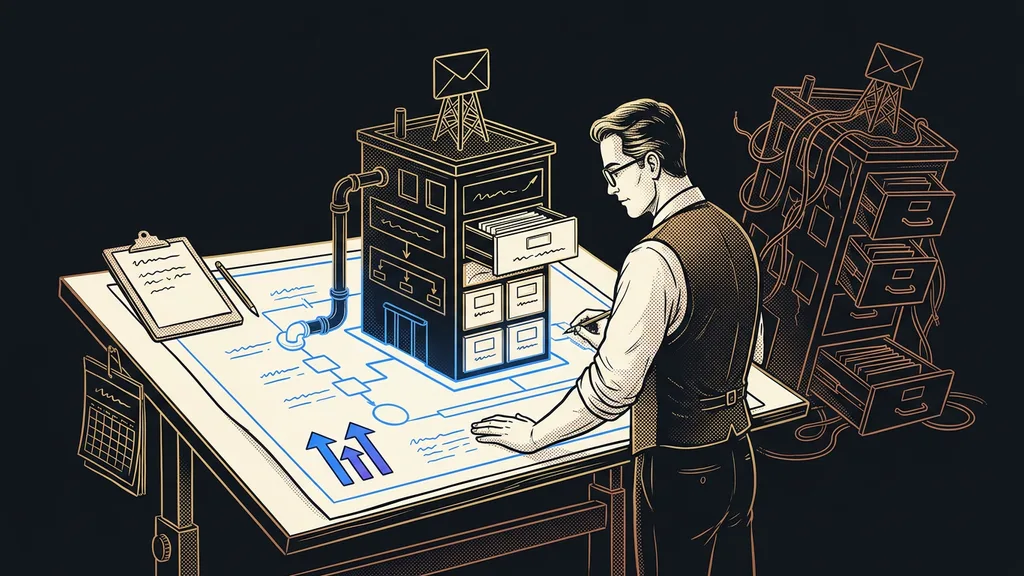
In most businesses, ad copy gets made one piece at a time. Someone sits down, writes a version for search and a version for social, and puts it out there. When it doesn’t work, they write two more a week later and wait again. So there’s never enough copy, and it all sounds almost the same.
I know it from my own work, too. I used to sit over one headline for twenty minutes and then throw it away anyway. The words weren’t the problem. I didn’t know precisely enough what I was actually promising that person, so I kept rephrasing the same thing over and over.
What you’re missing is the argument, not ideas
When you can’t face writing another variant, your imagination is rarely to blame. What’s missing is a well-thought-out argument you could derive the variants from. Without it, every headline starts from zero, and writing turns into a grind.
Selling argument
One sentence that says who you’re writing to, what changes in their situation, and how you’ll prove it. It’s the raw material headlines are made from, rather than a slogan or a headline itself. Until you’ve written it down, you start from scratch every time, and the result depends on your mood. Once you have it, a variant takes a minute.
There’s one telltale sign. When you find yourself debating individual words in the copy, the argument is missing. When it’s done, you debate which angle will work better, and that’s a useful debate to have.
And a good argument isn’t dreamed up at a desk. It comes from what customers say themselves: in meetings, in inquiries, in reviews. All you have to do is write down their sentences exactly as they said them. The best ad copy is often the customer’s own wording, just shortened.
Ten ads from one idea is an afternoon’s work. Ten ideas for ten ads is a month’s work, and you still don’t know which one holds up.
Every platform reads the same sentence differently
The same argument needs a different coat on every platform, because people run into it there in a different frame of mind. In search, they’ve asked about the problem themselves and mainly want confirmation that they’re in the right place. In a social feed, they aren’t looking for anything, and the copy has to stop them first. On a professional network, you’re talking to someone who’s at work right now.
Then come the hard limits. Every format has a different character count for the headline and the body, a different image ratio, and a different button. Trimming by hand then mangles the copy right where it carried the promise. I know the same difference from organic content, where you can’t just dump one text into five networks either.
Write the argument once, and the formats fall out on their own
Once the argument is done, variants stop being creative work and become a craft. I state who it’s for, what we’re promising, and how we prove it. Then I ask for a stock: search headlines, shorter and longer versions for the feed, each one already within that platform’s limit.
What sets variants apart is the angle, not synonyms. One ad goes for the result, another for the worry about delays, a third for curiosity. The core stays the same, so nothing promises something different anywhere. And when I need an acted video spot or an image in my own style to go with the copy, it starts from the same sentence.
This consistency has a side benefit that only shows after a few months. A customer comes across your brand in three places and hears the same promise each time. They don’t have to piece anything together, and they never feel like they’re talking to someone else. So the ad works on today’s order and also on whether they remember you at all.
A one-minute self-test
Take the last ad you ran. Can you say in one sentence who it’s for, what changes for that person, and how you prove it? If you hesitate on any part, what you’re missing is the argument the copy could be derived from, not the copy itself.
Ad fatigue
When the same people see the same ad so many times that they stop reacting to it. Performance drops even though nothing about the campaign changed and the budget stayed the same. The only defense is a stock of variants you can keep topping up from. If you have one ad, you have nothing to replace it with.
You can’t test without a stock of copy
You can only test what you have more than one of. Two variants side by side, the same audience, and a single difference in the copy: after a few days, you can see which angle people go for. With a stock of copy, you can do this every week. Without one, once a month.
For this to be worth anything, you need to know what each ad brought in. All it takes is giving each variant its own link, and then your report shows orders instead of impressions. It’s the same logic as content that gets produced and approved on an assembly line. The machine produces, a human decides.
One thing doesn’t change, however much copy you have. Only what you’ve read yourself goes out. Customers see an ad before you do, so a typo or a clumsy promise is hard to take back. A few minutes of reading costs less here than any fix afterward.
Who it doesn’t pay off for
So who doesn’t it pay off for? If you run one campaign a year and let it run, a stock of twenty variants won’t do you any good. It pays off once you advertise regularly and in several places at once.
It won’t help anyone who has nothing to say, either. An empty argument produces twenty empty ads, just faster and with the right character count. This setup speeds up production. It won’t replace the idea.
The whole process in a nutshell
- I write one sentence of argument: who it’s for, what changes, how I prove it.
- I add where the copy will run and what tone people use there.
- I have a stock of variants produced, already within each platform’s limits.
- I read them and approve only the ones that hold up. Nothing goes out without my yes.
- I run two against each other and let the numbers decide after a few days.
Those twenty minutes over one headline weren’t wasted after all. What I was really doing was working on the argument, just without paper and under pressure. Once you write that one sentence properly, headlines are just its costumes. Good advertising starts with one sentence you mean seriously. Inventing more sentences won’t get you there.