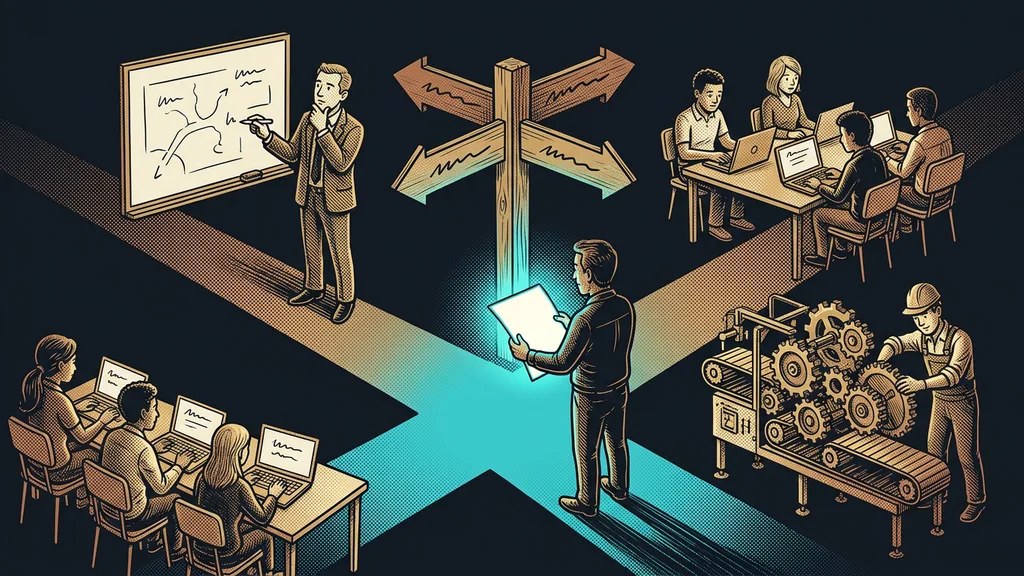
AI consultant, training, or vendor? A small business usually picks whoever got in touch first. Yet each of the three solves a different problem: a consultant solves what to do, training solves how your people will handle it, and a vendor solves who builds it. Help aimed somewhere other than where you’re stuck won’t pay for itself.
I see this scene at almost every intro call. On the table there’s an offer for a course for the whole team, next to it a price for an “AI strategy,” and in the inbox, another offer for a chatbot. All three offers are decent. But when I ask which work the business would most like to stop doing by hand, nobody has an answer. And without one, you can’t sensibly pick any of them.
Three kinds of help fix three different bottlenecks
A consultant helps when you don’t know what to do. Training is for when the what is clear, but your people can’t do it yet. And a vendor steps in once both the what and the how are settled, but nobody has time for it.
AI consultant
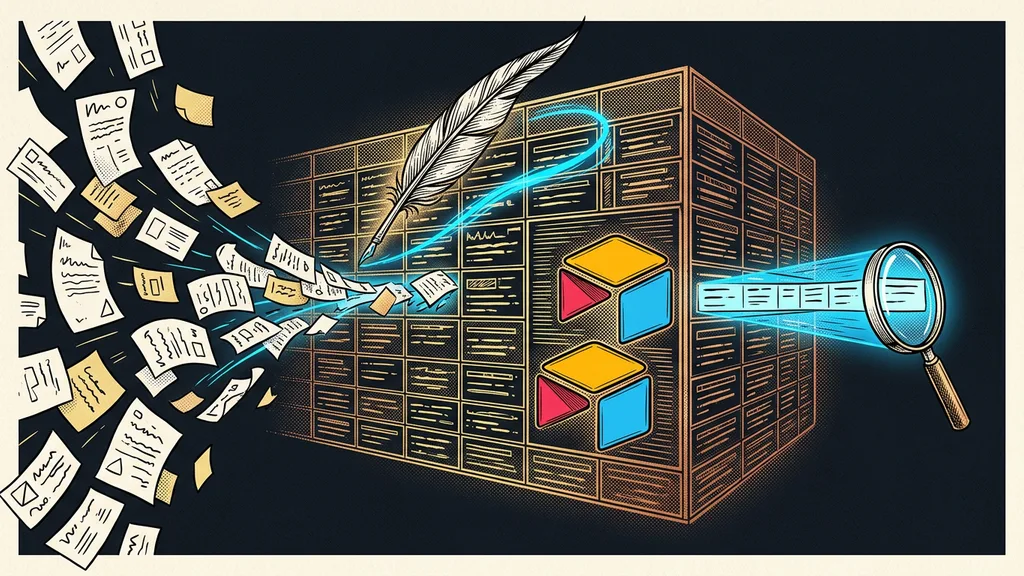
An outsider who goes through what your business does by hand and recommends where to start, with which tool, and in what order. What you get is a decision, not a finished system. A good consultant also tells you where AI doesn’t make sense yet.
| Where you’re stuck | Who to look for | What you should have at the end | When to be wary |
|---|---|---|---|
| You don’t know where to start | a consultant | a ranked list of tasks and a first step | you get a presentation about the future but no first step |
| You know what, your people can’t do it | training | people who can handle their task on their own | they practice on sample exercises, not on your work |
| You know what and how, but lack time | a vendor | a built and tested system | you don’t know the price up front, or the accounts aren’t yours |
Paying for a build before you know what to build is the most expensive way to find out what you wanted in the first place.
When does an AI consultant make sense?
An AI consultant makes sense when you have more ideas than certainty, or when there are offers on the table you can’t compare. You’re paying them to help you decide, not to build.
A good consultation ends with a short list of tasks, not a twenty-page strategy. The list is ranked by how much time each task costs you and how easily it can be handed off. The decisions are about individual tasks, not the whole business at once, much like the six questions for deciding whether a job should go to a person or an automation. What the work costs you today is part of the decision too. You can work out what one hour of manual retyping costs you before the meeting.
Be wary when a consultant recommends a single tool, and it just happens to be one they sell. The same goes if, after the meeting, you still don’t know what to do on Monday morning.
Training pays off at the end rather than the start
Training helps when you know what you want to do and your people are supposed to do it themselves. It pays off most when people learn on a task or a system that’s already running in the business.
A course at the start, when the business doesn’t know yet where it’s headed with AI, gives people an overview and a good mood. Then they go back to their desks with nothing to apply the new knowledge to. Training on your own work is different, because people learn exactly the task that’s waiting for them tomorrow. That’s why I build my Claude training for teams around participants’ real tasks, not practice exercises.
Where the work should run on its own, training isn’t enough. After a course, a person still does the work with their own hands, just more skillfully.
Finish one sentence
Write the opening “A month from now, we want…” on a piece of paper and finish it without overthinking. If you don’t know how to finish the sentence, you’re looking for a consultant. If it comes out as “…our people to be able to do it,” you’re looking for training. And if it comes out as “…it to run by itself,” you’re looking for a vendor.
When you need a vendor to build it
You need a vendor when you know which work you want off your plate, and that work runs through several tools. Typically, it’s an inquiry that has to travel from a form through your CRM all the way to an invoice, or a chatbot that answers from your company’s documents.
You won’t learn to build that kind of connection in an afternoon, and your people don’t have time for it on top of day-to-day work. I cover exactly what a vendor should hand over in my article on what AI implementation is and what happens during it. Here, four things are enough, and you want them in writing: a proposal with the price up front, a test on your real data, accounts in the company’s name, and documentation.
Vendor lock-in
A situation where the system runs on the vendor’s accounts, or only the vendor understands it. Without them, the business can’t change, move, or shut down anything. One question tests it: what would happen if your vendor called it quits tomorrow?
A sensible vendor also won’t start with a big project. They’ll start with one task you can measure, exactly the way you bring AI into a business, one step at a time. If it proves itself, you build on it. And if a business needs all three kinds of help, the order is usually this: consultation, build, and only then training. Often one person does all three. Then just make sure they also recommend things they won’t be building themselves.
When I’m not the right choice
In some situations, I’ll tell you myself to go elsewhere. I say it up front, because the wrong kind of help costs both sides time.
- You just want an overview for the whole team. For a first introduction to AI, a cheaper general course is enough. Custom training makes sense once you have a specific task.
- You need a legal opinion. What the EU AI Act or GDPR requires of your business should be assessed by a lawyer, not by someone who builds automations.
- You have your own IT department and a large information system. With me, you always talk to one person. That’s an advantage only until you need a team and contractual availability around the clock. That calls for a bigger vendor.
- You have one simple routine and you’re keen to learn. You can handle a first step like that on your own and pay for help only with the next thing.
The whole choice in a nutshell
- Finish the sentence “A month from now, we want…” and its ending tells you who to look for.
- Don’t know how to finish it? Start with a consultation that produces a ranked list and one first step.
- Should the work run on its own? Look for a vendor, and get the price, a test on your data, accounts in the company’s name, and documentation in writing.
- Should your team handle the work? Book training on your own tasks, ideally around what’s already running.
- With every recommendation, check whether it ends at a tool the person recommending it sells.
So you don’t have to compare those three offers on the table by price. Just hold them up against one finished sentence, and two of them usually drop out on their own. If it comes out as a consultation or a build and you’d like to talk it through with me, see how rolling out AI with me works. The first consultation is free and online. Whatever you decide, grab a piece of paper today and finish that sentence before you reply to the first offer.