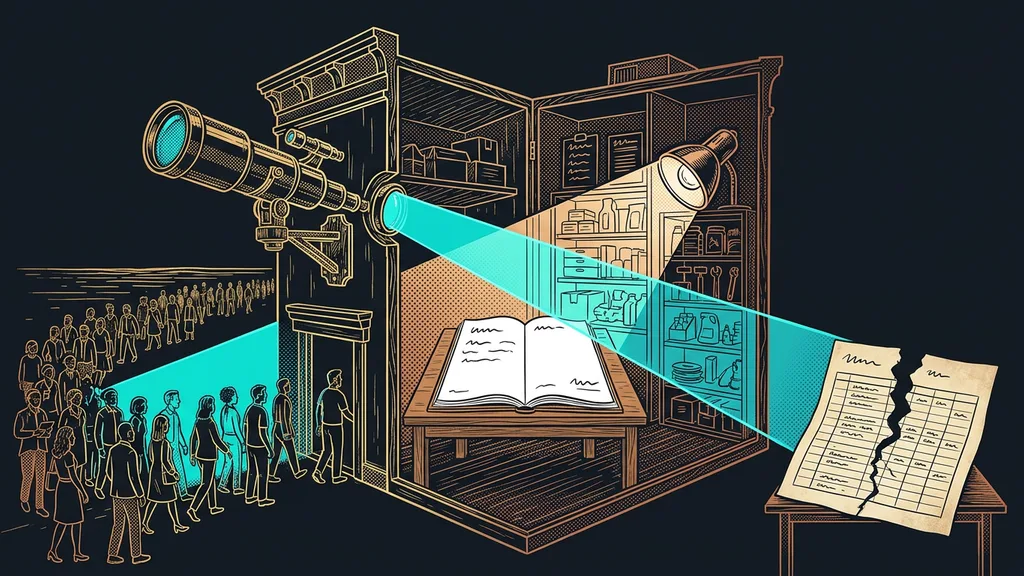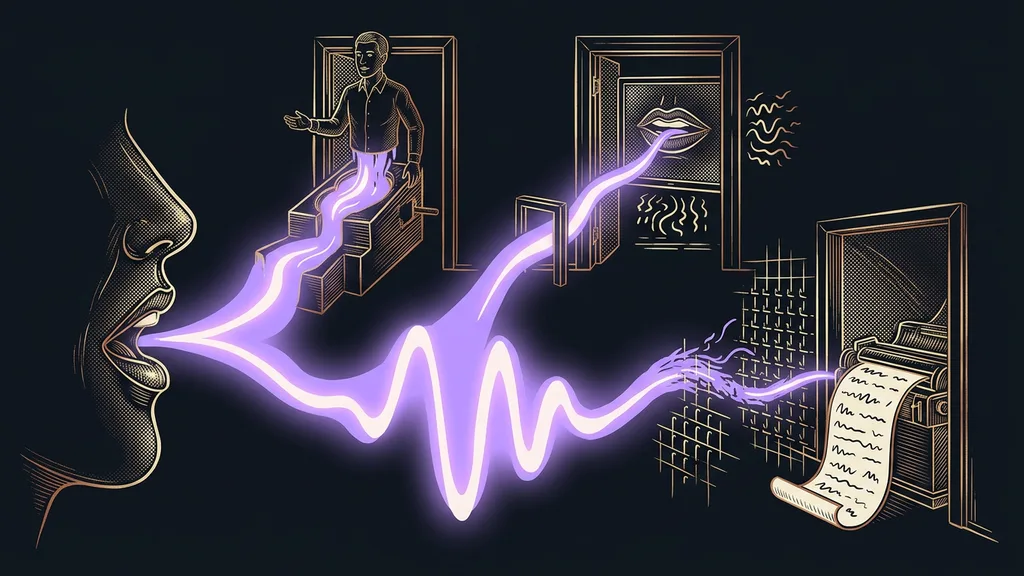
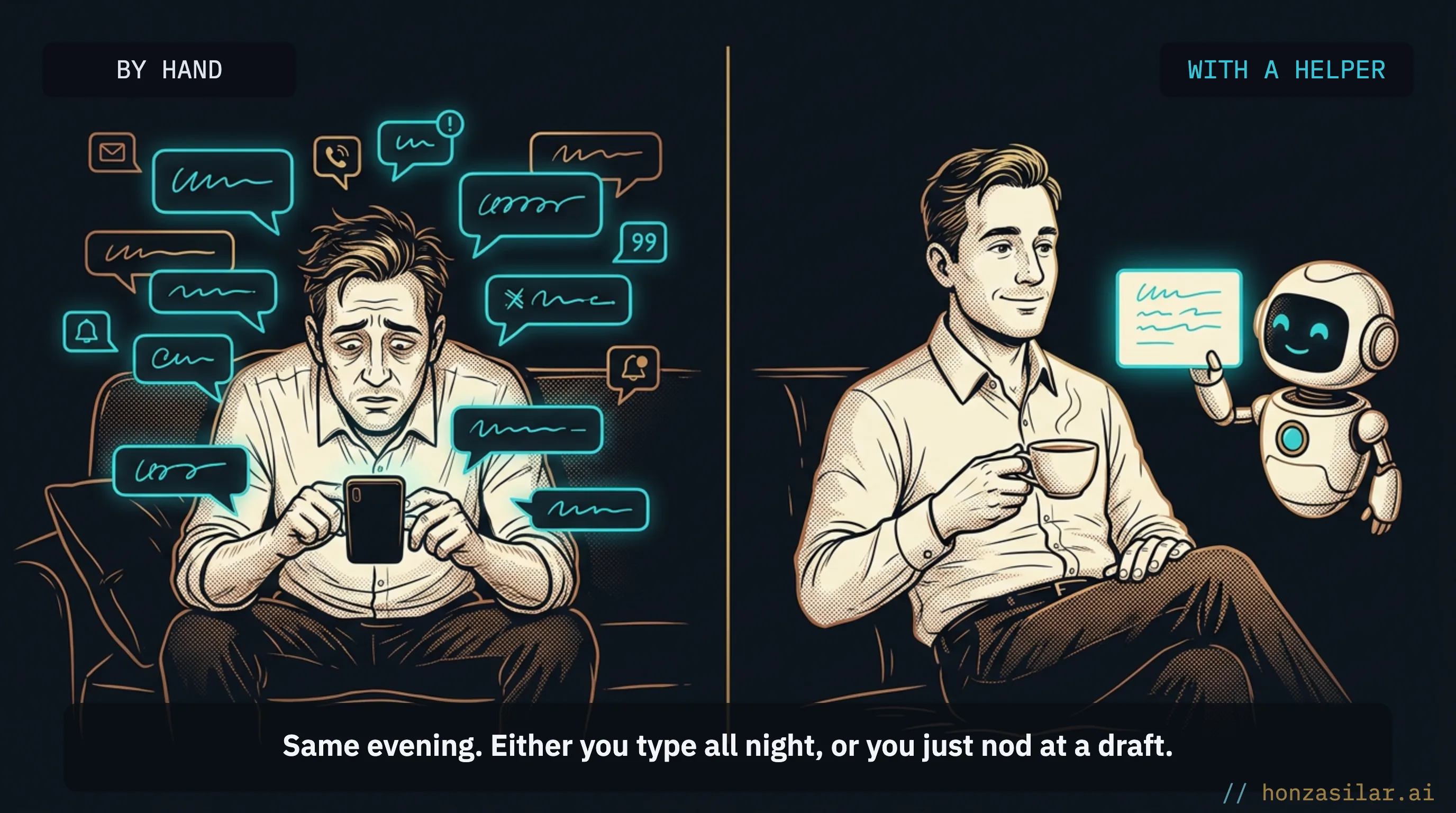
Answering clients in messages is work you can’t pass on. It falls to whoever knows the tone and the history with that particular person, and that’s usually you. So every evening, a task that gets you nowhere and just keeps you glued to your phone eats up half an hour.
I know it by heart. The WhatsApp number my clients wrote to was slowly turning into a bottomless pit. Replying to one person takes a few minutes, but there are eight conversations, and the half hour is gone. And so it went, evening after evening, seven days a week.
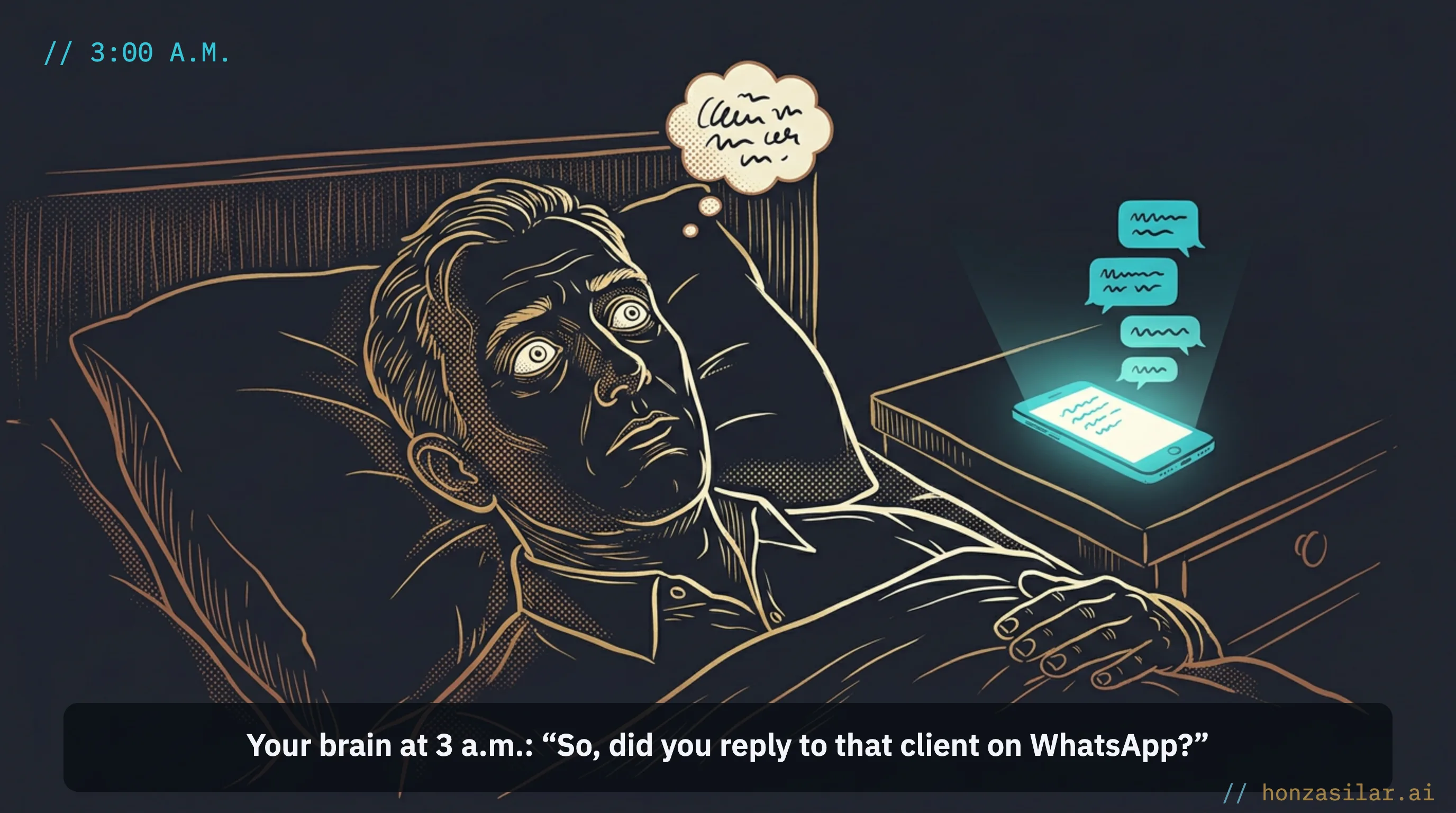
The most expensive work is the kind nobody can take over
I can write just fine. The heart of the problem is that this work can’t be passed on. An assistant can’t reply for me, because they don’t know my tone or my history with that person. So I’m the one sitting by the phone, the only one who can write it “like me.”
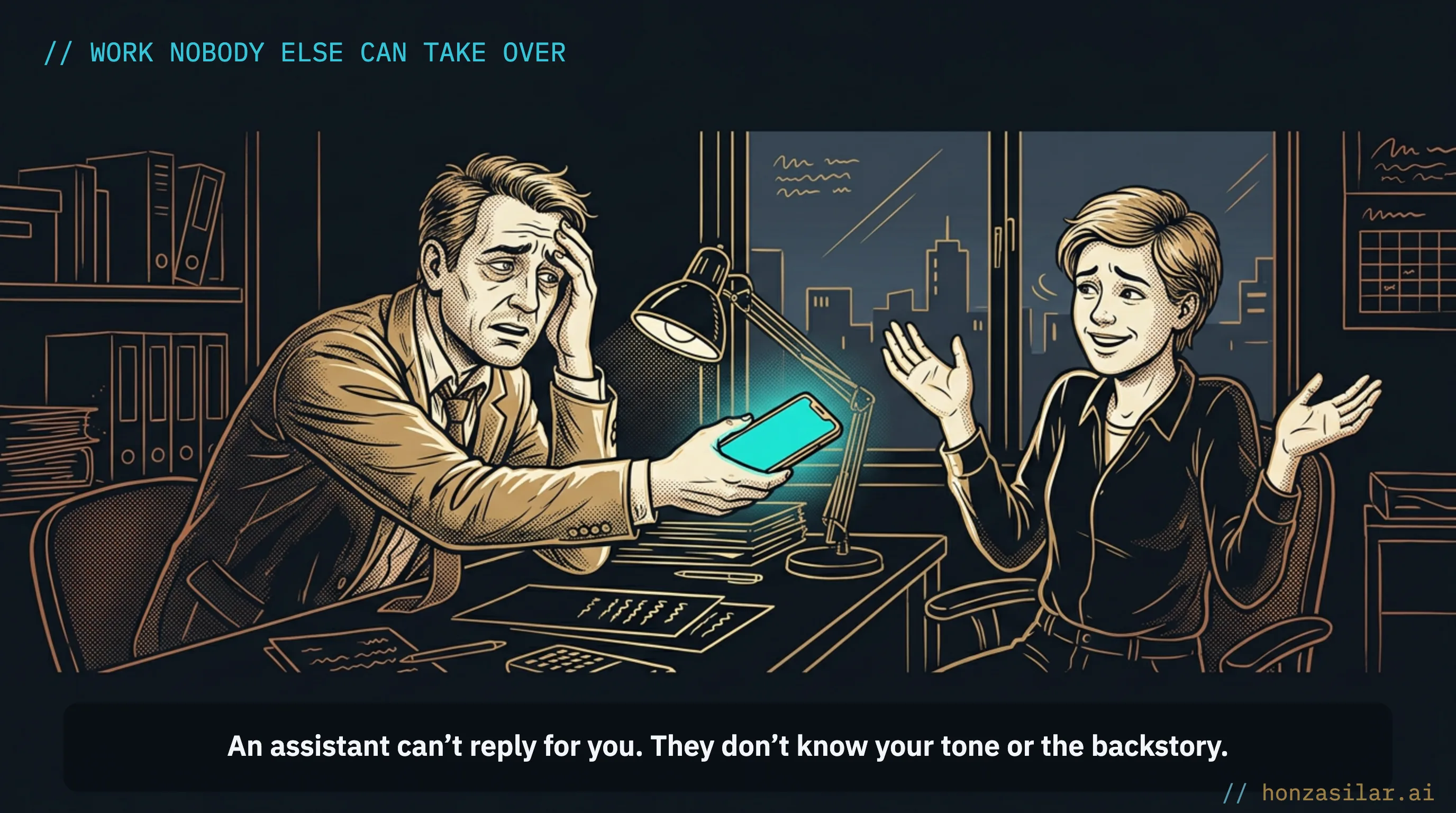
Simple work that only you can do costs more than hard work does, because nobody can take it off your hands.
The one-minute self-test
Take the past week and count how many evenings you spent answering messages. Half an hour a day adds up to almost two working days a month, on a task that gets you nowhere. How many of those replies could someone else easily write for you, if only they had your tone?
One-minute self-test: what evening messages cost you
Drafts that sound like you, down to the right form of address
I built myself a helper that drafts those replies for me. Forget “thank you for your message” and robotic phrasing. First it reads what the conversation is currently about, so the draft picks up on whatever was discussed a moment ago. Above all, it gets your voice right: it learns from how you actually write, and it even catches a detail that matters so much in Czech, namely who you address with the informal “ty” and who with the formal “Vy.”
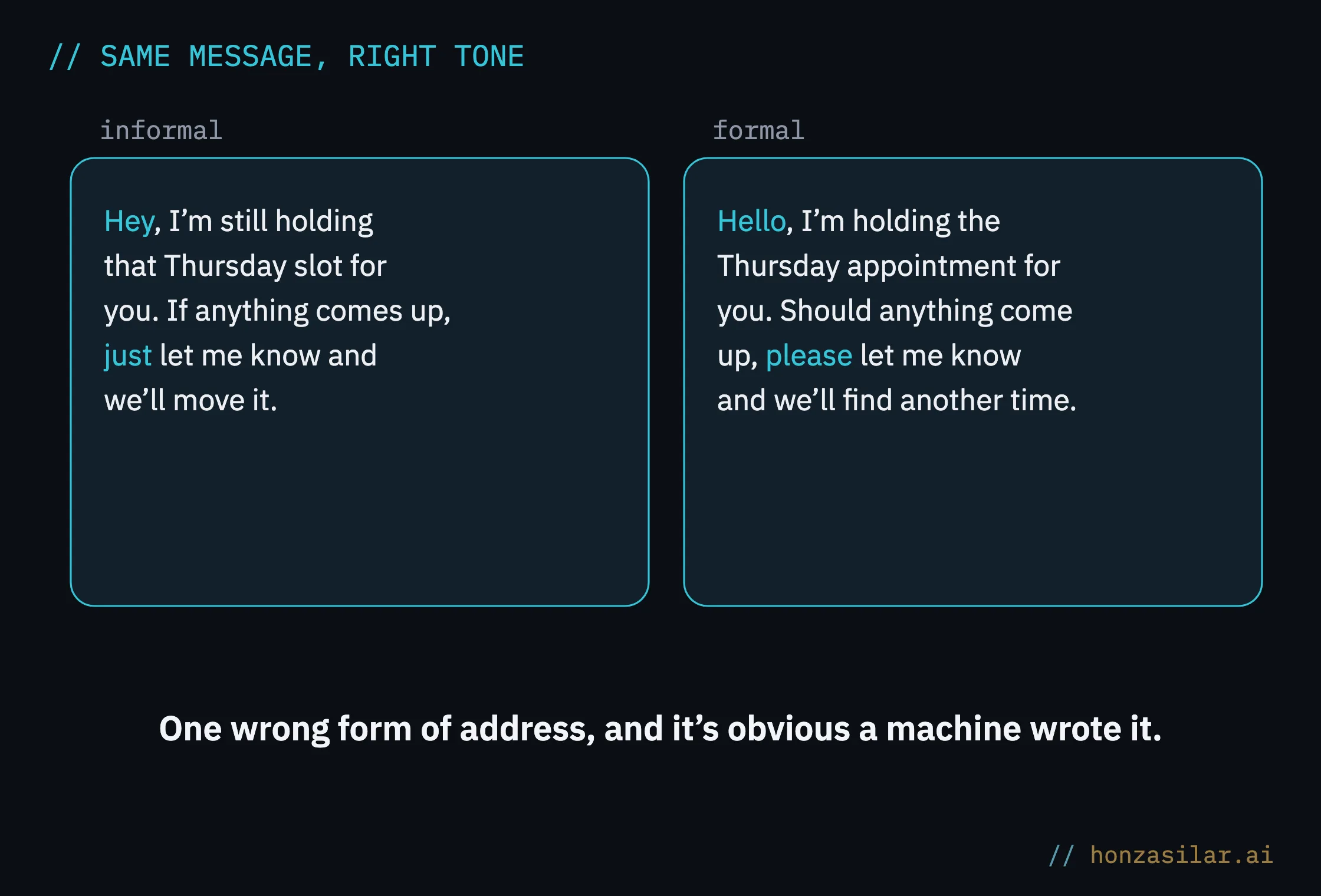
Here’s roughly what it looks like. A client asked about an open slot and then went quiet for two days. To someone I address informally, the AI suggests: “Hey, I’m still holding that Thursday slot for you. If anything comes up, just let me know and we’ll move it.” Someone I address formally gets the same message like this: “Hello, I’m holding the Thursday appointment for you. Should anything come up, please let me know and we’ll find another time.” One wrong form of address, and it’s obvious a machine wrote it.
It can handle several people at once, too. When I need to message a group at the same time, I say who I want to reach, and a few minutes later I have five different messages. Each one is worded differently, and each fits its person. And they don’t look like a batch fired off in a single second.
Your number stays on your phone
Your WhatsApp Business number keeps running on your phone, and you write from it normally, as always. Alongside that, though, every conversation is mirrored to one place, so the helper has the whole history with each person in one spot. This mode is called Coexistence, and the beauty of it is that you don’t switch anything off and you don’t lose anything.
Coexistence
Coexistence is a WhatsApp Business mode in which your number keeps running normally on your phone while every conversation is also mirrored to one place where AI can work with it. You don’t switch anything off, you don’t lose any history, and the client can’t tell a helper has joined behind the curtain. True to its name, the phone and the system hold the same conversation side by side.
What matters is the route the messages take. The connection runs through Meta’s official API, not through a back door. That significantly lowers the risk of WhatsApp blocking your number. The risk doesn’t disappear entirely, and nobody honest would promise you that, but you’re on the route Meta itself wants businesses to use. And that’s exactly where cheap back-door solutions eventually come unstuck.
Three fears about AI on WhatsApp, and the reality
The helper minds Meta’s rules for you
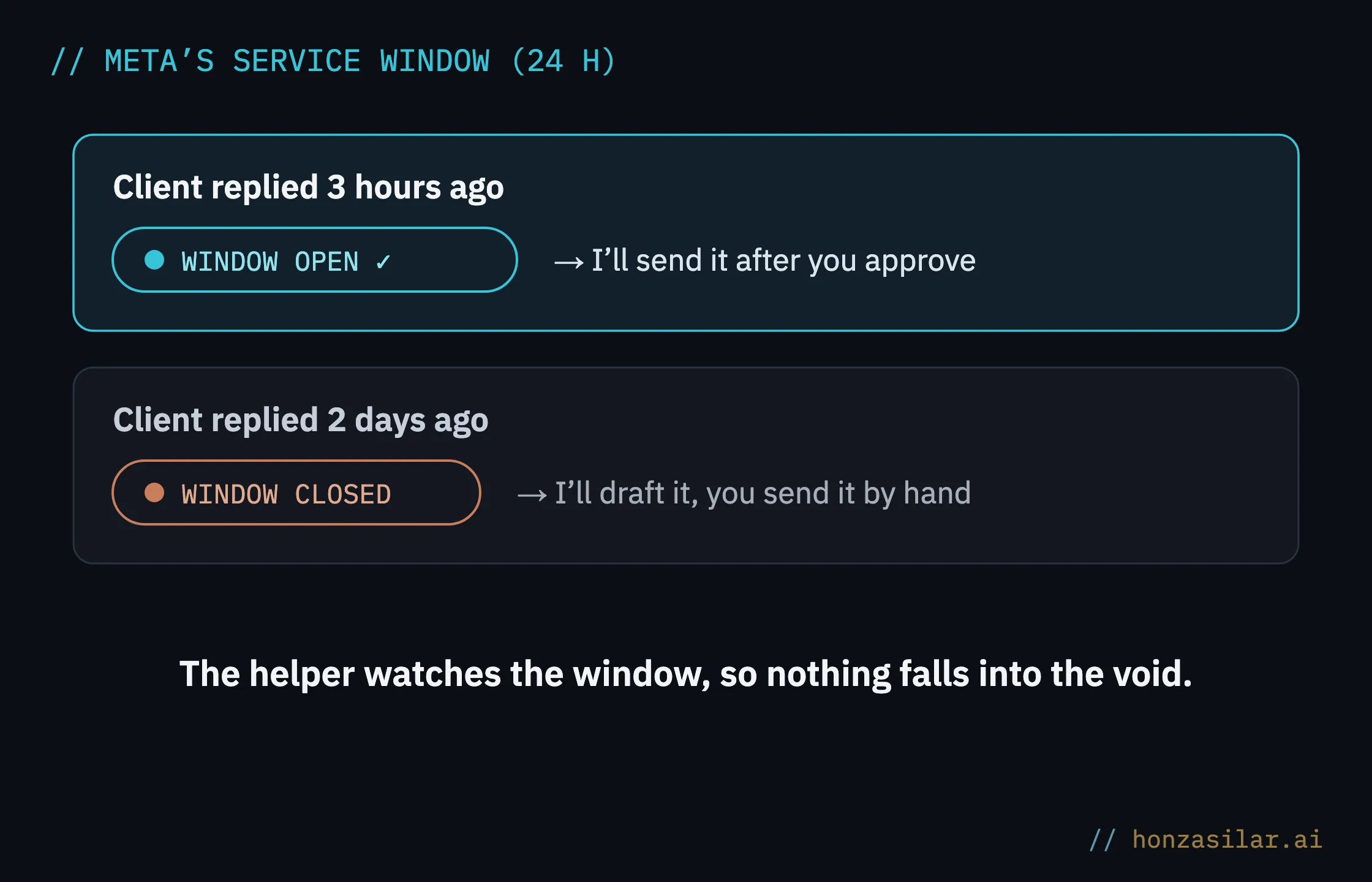
Meta has its rules, and one of them can sink even a well-meant message. You can proactively message a client outside a template only within the so-called service window. The helper keeps track of it on its own: for every conversation, it knows whether the window is open. If it is, it sends the message once you approve. If it has expired, it doesn’t force anything. It prepares the finished text, and you send it by hand from your phone with one tap.
Meta’s service window (24 hours)
The service window is roughly 24 hours from the client’s last reply, during which you’re allowed to send them a regular message outside a pre-approved template. Once the window expires, a regular message won’t go out, and you have to use a template or write by hand. The rule protects people from being flooded and protects businesses from writing into the void.
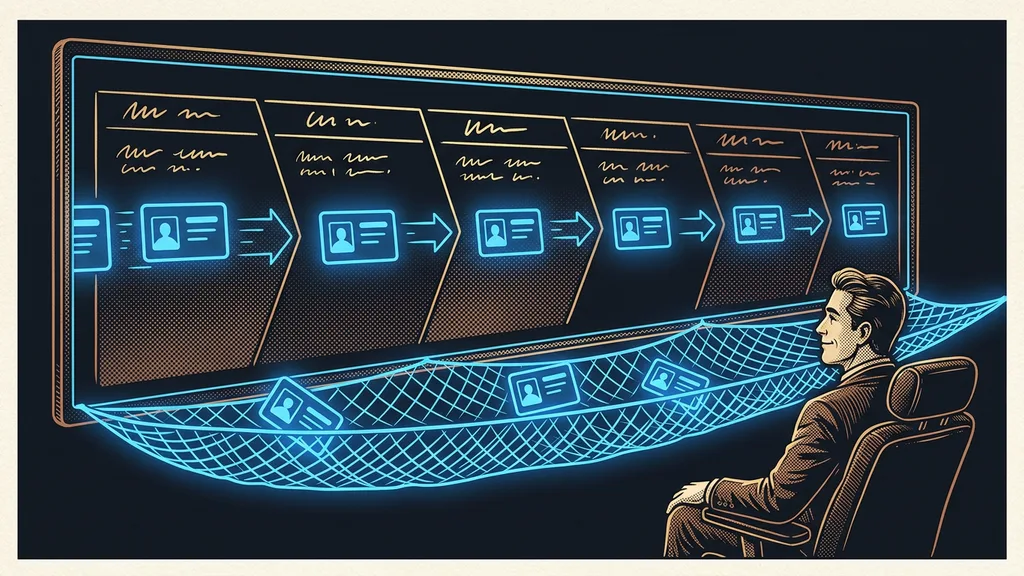
The safety net
Either it runs automatically and cleanly, or it alerts you on its own and leaves the last step to you. You don’t put your number at needless risk, and you follow Meta’s rule.
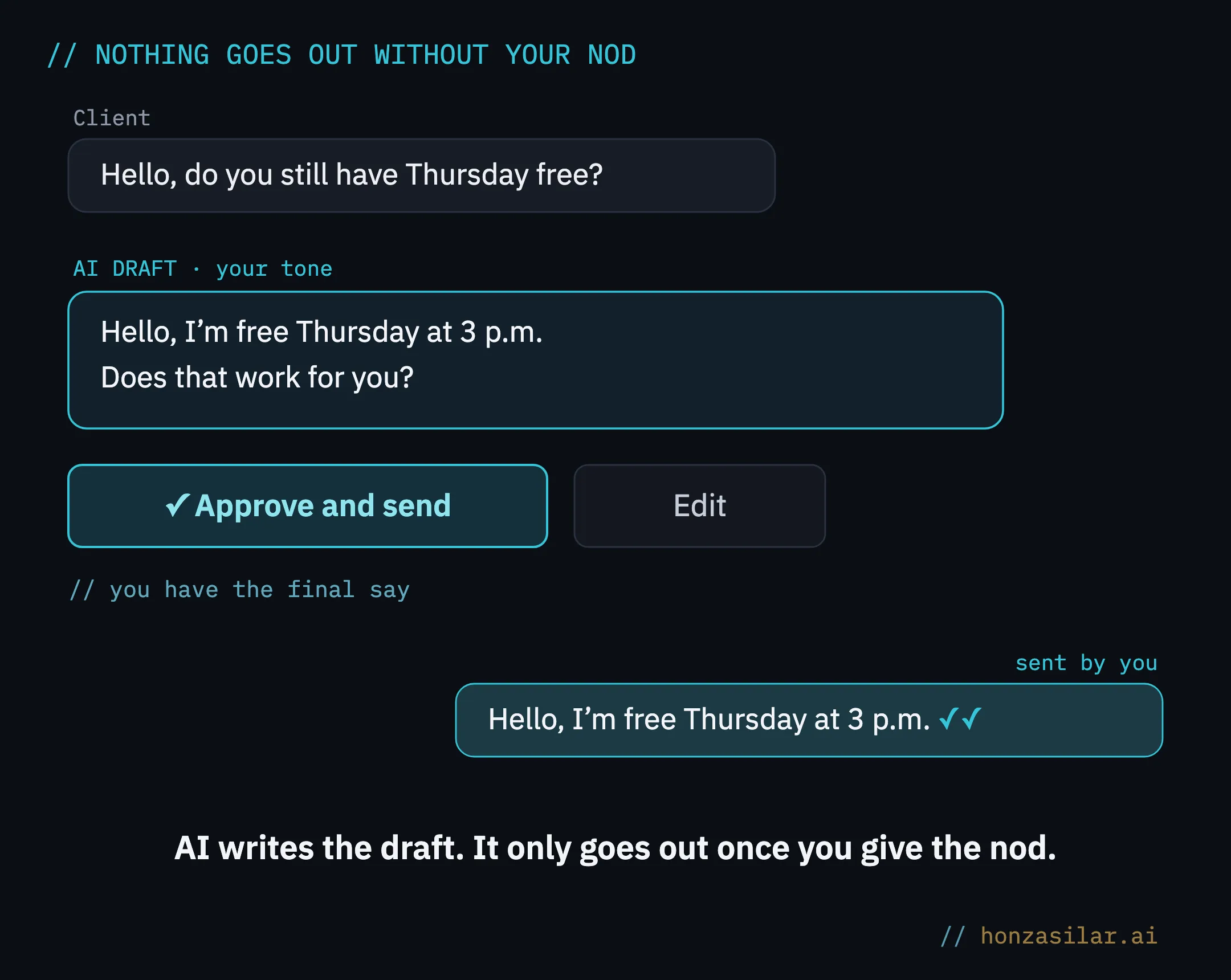
Nothing goes out without your nod
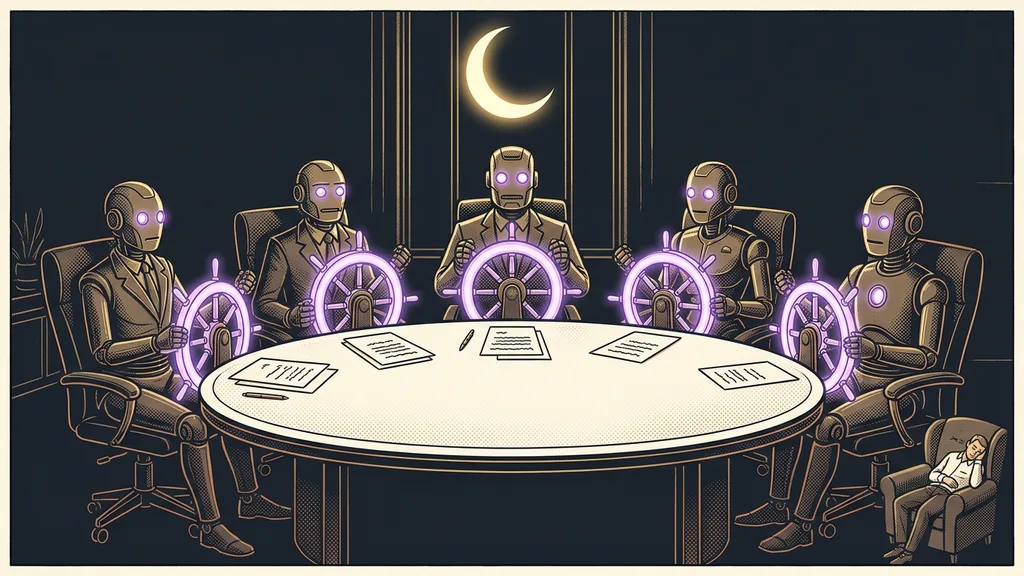
This is the heart of the whole system: the final say stays with you. The AI does the boring part, reads the context, and minds Meta’s rules. You get a finished draft and decide just one thing: whether it goes out or not. Here’s what disappears from your evenings:
- half an hour a day spent typing into your phone word by word,
- deciding who gets the informal “you” and who the formal one,
- worrying whether a bulk message sounds like a bulk message.
Answering on WhatsApp: before and now
Before
Half an hour of typing into your phone every evening.
You agonize over who gets the informal or formal “you.”
Worrying whether a bulk message sounds like one.
Now
“I read the draft and nod.”
AI writes in your tone, with the right informal or formal “you.”
Nothing goes out until you approve it.
So who isn’t it worth it for? If you get a few messages a week and can handle them off the top of your head, the system won’t give you anything. It also isn’t worth it if you don’t want to entrust personal communication to AI, not even as a mere draft. That’s a legitimate choice. It only pays off where there are so many messages that they’ve started costing you whole evenings.
The whole system in a nutshell
There’s no magic, just a few connected pieces and one dispatcher on top that knows when to pay attention:
- Your WhatsApp Business number connects through Coexistence mode to an environment where all conversations come together.
- On top of that sits an AI that reads the context of every conversation and keeps your tone, including the informal or formal “you.”
- For every message, the helper checks Meta’s service window, so nothing falls into the void.
- You get a finished draft. Nothing goes out until you approve it.
- With one tap, you send the message, or you don’t.
It’s the same AI that can answer customers in proper Czech on your website or by email, too. And you can build the same thing for calls you can’t pick up in time: the channel changes, the principle stays.
How much a messaging helper writes tells you little. A good one still sounds like you and leaves the final say with you. The work is still there, but someone else does the grind, and you’re left with the one thing nobody can do for you: give the nod, or don’t.