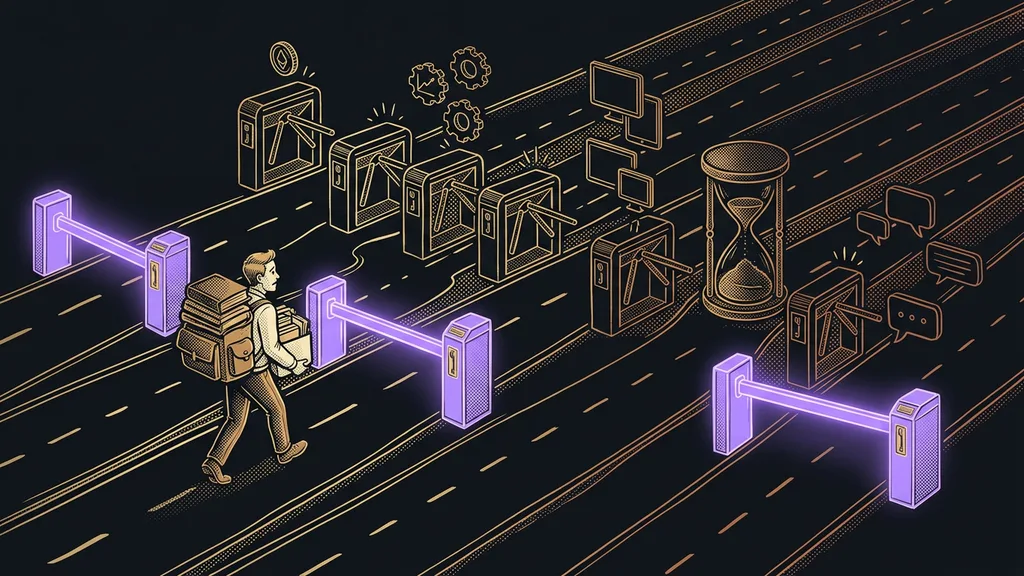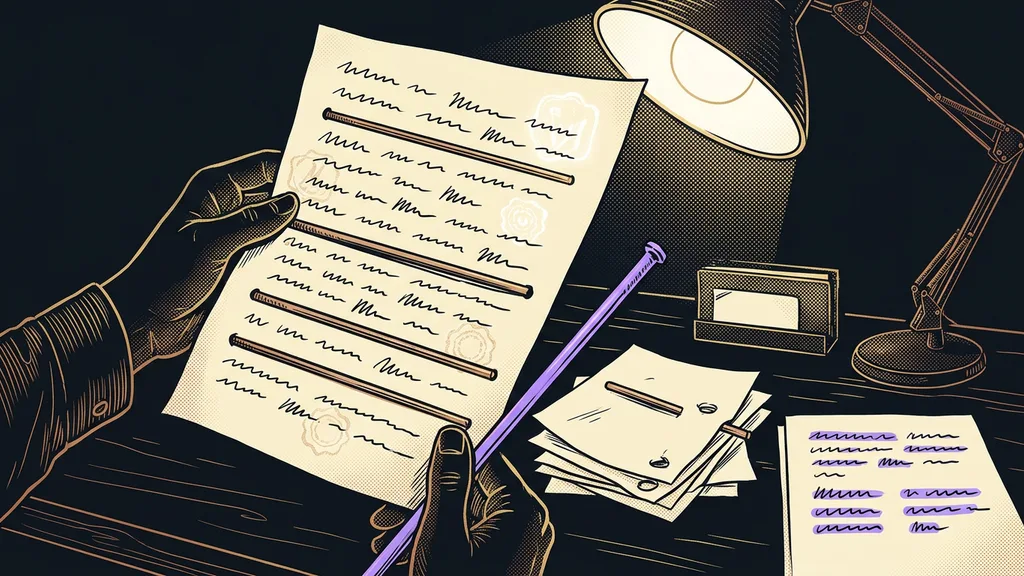
People can spot machine-written text these days, and mistakes aren’t what gives it away. There are usually fewer of those than in text written by a person. What gives it away is the trail the machine leaves behind: one punctuation mark, the symmetry of the paragraphs, and words nobody would say out loud. And once readers have seen it, they read the whole text differently.
A client told me so point-blank when we were going through the texts for her website. She didn’t mind that AI had been involved. What bothered her was that you could see it at first glance, and that her customers would see it too. That day I wrote it down as a hard rule, and I’ve stuck to it with every text since.
It shows in the fingerprint, not the quality
Quality has nothing to do with it. Machine text is often grammatically cleaner than yours, and readers catch it anyway, because they’re looking for a familiar pattern, not for mistakes.
Machine fingerprint
The set of small details a language model leaves in a text, which even a layperson notices after a while. None of them is a mistake. Together they form a rhythm, punctuation habits, and a vocabulary that never all show up at once in a human writer. You can erase the fingerprint, but only by rewriting, not by proofreading.
The worst part is what it does to trust. The reader won’t conclude that you used a tool. What crosses their mind is that you couldn’t find the time for them. And in a proposal or an email to a client, that costs more than it seems.
“Those long dashes are typical of AI. Absolutely everyone can tell.”
The sign that gives a text away fastest
One single thing is behind most of the giveaways: the em dash in the middle of a sentence. That’s the wide line that sets off an aside. It has its place in Czech typesetting, but nobody finds it on the keyboard.
That’s exactly why it works as a signature. Someone writing quickly without any help just won’t put it there. They’ll type a comma, a period, or a parenthesis, because those are right under their fingers. Language models, on the other hand, love dropping it in, and often, so it can easily appear two or three times in one paragraph.
And one is enough: the reader notices it, perks up, and reads the rest of the text with suspicion. The same goes for the en dash, the slightly shorter one, when it sits inside a sentence in place of a comma. In a range of numbers it’s fine. Anywhere else, it gives you away.
Four more clues you can find in a minute
The dash is the most noticeable, but it isn’t the only one. The other four are just as easy to look for, and you’ll find them even in a text without a single dash.
- Symmetry. Three points, three examples, three paragraphs of the same length. People don’t write like that, because one idea always grows on them and another gets brushed off in a single sentence.
- Sentences that correct themselves. “It’s not about speed, it’s about calm.” Once per text, it’s decoration. Three times in a row, it’s a signature.
- Words nobody says out loud. Robust, crucial, effectively, last but not least, in today’s fast-paced world. Try saying a sentence like that to a colleague over coffee, and you’ll immediately realize it has to go.
- Nothing specific. Not a single number, name, or personal experience. A text that could be used unchanged in any industry wasn’t written by anyone who actually works in that industry.
One-minute self-test
Take the last text you sent out and do two things. Find every em dash in it. Then read it out loud, all of it, slowly. Wherever you trip over your own sentence, it wasn’t written by anyone who talks like that.
The fix is rebuilding the sentence, not swapping the character
Swapping the em dash for a shorter dash isn’t enough, because the sentence structure stays the same and still looks machine-made. You fix the construction, not the punctuation mark.
Rebuilding the sentence
A fix that changes the construction rather than the character. An aside between two dashes breaks into two separate sentences, or becomes a parenthesis, a colon, or a plain comma. The meaning stays, the rhythm changes. This is the only fix the reader will appreciate.
You know the replacements from school, and there are four. A period splits a long sentence into two, and a comma handles a short aside. A colon introduces an explanation or a list, and parentheses tuck away a note that doesn’t belong in the main sentence. The fifth option is the best and the least used: rearrange the word order so that no punctuation mark is needed.
The fastest defense I found wasn’t in proofreading at all. I dictate the first draft in my own words and only then have it polished. The fingerprint has nowhere to form, because the rhythm is mine from the start. Which tools write better Czech and which write worse, I compared in an overview of seven tools for writing copy.
The same trap waits in foreign-language versions. A native speaker spots a translated text just as easily as you spot machine-made writing in your own language. That’s why an English or Polish version shouldn’t be produced by translation from your original. It should be written directly in the target language, with its own turns of phrase.
When it matters less
So when don’t you need to bother? With an internal note, meeting minutes, or a document only your team reads. There it’s about the content, and nobody judges you by a dash.
The second exception is a technical text full of tables and numbers, because the reader is looking for data, not sentence rhythm. Just be careful the exception doesn’t become a habit. Whoever gets used to machine sentences inside the company soon starts writing them for the outside world too.
And more texts go out than you’d think. Besides your website and proposals, there’s every bulk email that goes to hundreds of people at once, and there are the suggested replies to messages, where your tone has to be right. When content is produced in larger volumes, for example in a system that publishes on its own, this check has to be a fixed part of the process, because you can’t rely on a voluntary one.
The check in a nutshell
- Go through the text and get rid of every em dash. By rebuilding the sentence, not by swapping the character.
- Break the symmetry. Let one paragraph run longer, and let another have just two sentences.
- Throw out words you wouldn’t say out loud to a colleague.
- Add at least one specific thing: a number, a name, your own experience.
- Read the whole text out loud. Wherever you trip, rewrite the sentence.
- For a foreign-language version, don’t translate. Have the text written directly in that language.
Let’s go back to that client who spotted it before I did. She didn’t mind that AI was involved in the text. What bothered her was that it showed. A good text isn’t measured by whether you can identify the author. With a good text, you never even think about who wrote it.